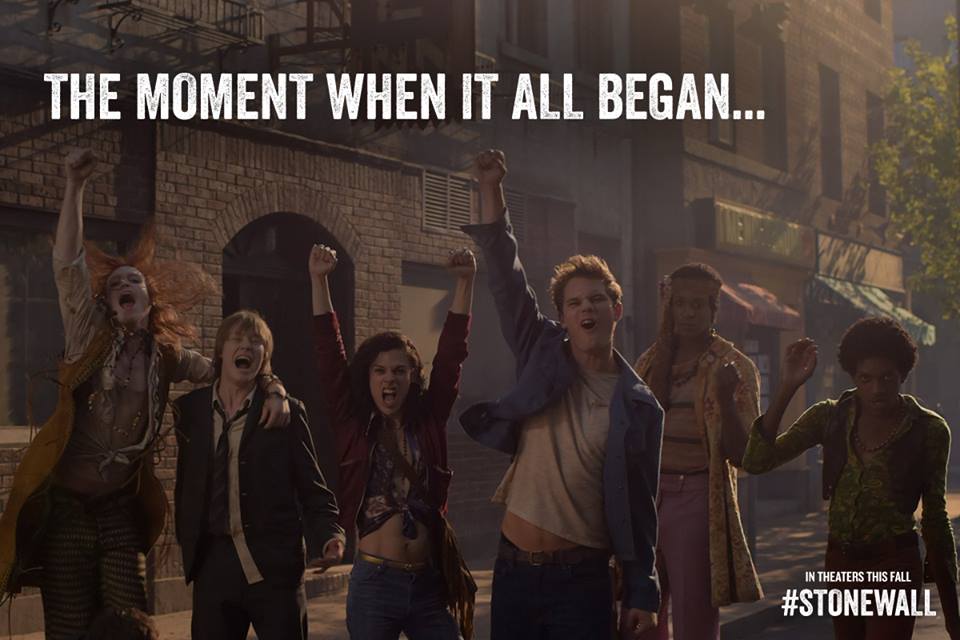
ABC has ordered the gay-rights miniseries “When We Rise” from “Milk” screenwriter Dustin Lance Black, according to media reports.
Gus Van Sant will also serve as executive producer and will direct the first two-hour episode of the eight-hour miniseries, reuniting him with Black after previously directing the 2008 Harvey Milk biopic.
Produced by ABC Studios, “When We Rise” chronicles the personal and political struggles, setbacks and triumphs of a diverse family of LGBT men and women who helped pioneer one of the last legs of the U.S. Civil Rights movement from its turbulent infancy in the 20th century to the once unfathomable successes of today.
The series will tell the history of the gay rights movement, beginning with the Stonewall Riots of 1969. It was originally put into development at ABC in 2013.
Laurence Mark and Bruce Cohen will also serve as executive producers on the miniseries.
The Wrap.
Confirmed by an excited DLB.
But will it be as good as Stonewall The Movie?
Showing posts with label Stonewall movie. Show all posts
Monday, 21 December 2015
When We Rise: Soon
Labels:
Dustin Lance Black,
Gus Van Sant,
Milk,
Stonewall movie,
when we rise
Friday, 25 September 2015
Stonewall: Now And Then
The historical moment we call “Stonewall”—a series of grass-roots protests with complex motivations and diverse participants that took place in and around a divey Manhattan fag bar during the summer of 1969—has always been something of a Rorschach test: We see in it what we need to see...
Where a critic for the Hollywood Reporter was pleased with the movie’s encouragement of “political awakening,” Gawker’s Rich Juzwiak recoiled at a straight-pandering “monstrosity” whose “badness is nearly unfathomable.” Our disparate reactions to a movie like Stonewall can’t help but reveal personal preoccupations and wishes, and those, in turn, suggest a queer “community” that is very much unsure of where it wants to go next.
To be clear, taking Stonewall seriously in the way I have is not the same as offering a defense. It doesn’t warrant that. But I do think it’s worth considering why such a small, misbegotten movie—one that we could, as Salon’s Andrew O’Hehir suggests, just as easily nudge into the memory hole—has generated so much angst.
Stonewall was a moment when we all put aside our differences and united to finally fight back—or at least that’s what most of us want it to have been. Stonewall, on the other hand, comes at a moment when the always jury-rigged alliance between the various queer contingents feels more uncertain every day; when our debates over terminology, community norms, political goals, and paths toward social justice feel increasingly fractious.
Is it any surprise the stakes of this movie—our movie—feel so high? Usually cinema screens simply reflect back the light projected onto them—but sometimes, they act as mirrors for the audience as well. This is one of those times.
The Stakes Of Stonewall, J Bryan Lowder, Slate.
Only the brilliantly perceptive Mr Lowder could make Fagburn temporarily lift his ban on blogging about this sodding movie again.
PS The only other article worth reading on this hoo-hah is Tim Teeman's The Gay Shame Of Stonewall The Movie.
Anyway... No more on Stonewall, it's got boring.
Everyone's feigning outrage now, it's all a bit 'Cecil The Lion'.
PS And finally... here's Tommy Lanigan-Schmidt, your actual surviving Stonewall street kid...
The movie is pretty accurate in terms of the street kids being the main engine of things. In one criticism of this film, someone was saying they were angry because there were so many gay stereotypes. Gay stereotypes are what made it happen. The people who passed for straight hid and didn’t want to be active at the beginning. The straighter-acting people ran away.
Where a critic for the Hollywood Reporter was pleased with the movie’s encouragement of “political awakening,” Gawker’s Rich Juzwiak recoiled at a straight-pandering “monstrosity” whose “badness is nearly unfathomable.” Our disparate reactions to a movie like Stonewall can’t help but reveal personal preoccupations and wishes, and those, in turn, suggest a queer “community” that is very much unsure of where it wants to go next.
To be clear, taking Stonewall seriously in the way I have is not the same as offering a defense. It doesn’t warrant that. But I do think it’s worth considering why such a small, misbegotten movie—one that we could, as Salon’s Andrew O’Hehir suggests, just as easily nudge into the memory hole—has generated so much angst.
Stonewall was a moment when we all put aside our differences and united to finally fight back—or at least that’s what most of us want it to have been. Stonewall, on the other hand, comes at a moment when the always jury-rigged alliance between the various queer contingents feels more uncertain every day; when our debates over terminology, community norms, political goals, and paths toward social justice feel increasingly fractious.
Is it any surprise the stakes of this movie—our movie—feel so high? Usually cinema screens simply reflect back the light projected onto them—but sometimes, they act as mirrors for the audience as well. This is one of those times.
The Stakes Of Stonewall, J Bryan Lowder, Slate.
Only the brilliantly perceptive Mr Lowder could make Fagburn temporarily lift his ban on blogging about this sodding movie again.
PS The only other article worth reading on this hoo-hah is Tim Teeman's The Gay Shame Of Stonewall The Movie.
Anyway... No more on Stonewall, it's got boring.
Everyone's feigning outrage now, it's all a bit 'Cecil The Lion'.
PS And finally... here's Tommy Lanigan-Schmidt, your actual surviving Stonewall street kid...
The movie is pretty accurate in terms of the street kids being the main engine of things. In one criticism of this film, someone was saying they were angry because there were so many gay stereotypes. Gay stereotypes are what made it happen. The people who passed for straight hid and didn’t want to be active at the beginning. The straighter-acting people ran away.
Morrissey: Stop Me If You've Heard This One Before
I think the sex scene in Morrissey’s much-mocked first novel, List of the Lost, sounds quite fun: “A rollercoaster coil of sexually violent rotation with Eliza’s breasts barrel-rolled across Ezra’s howling mouth and the pained frenzy of his bulbous salutation.” I mean, that sounds better than the rollercoasters I’ve tried at EuroDisney. But the moral of Morrissey’s otherwise terrible foray into literature is: repression can be a wonderful thing.
I don’t mean repression for everyone. For humans, it’s not good, as a rule. But for artists, yes. As a teenager, like so many of my generation, I yearned with Morrissey, not for him. It was only in adulthood that I realised why: he was a gay man born in 1959, facing a triple whammy of Irish, Catholic, and Northern repression. No wonder he hated the gay scene, himself and everyone else, with a twisting, superior self-loathing that royally screwed him up for evermore.
But for everyone else, it was great. In the closet he became a songwriter of genius. Now, I look back and see he was hiding in plain sight — his best songs hissing with anger at forcing his self away. Yet it was coded enough that I never noticed at the time; I didn’t need to. Putting on record after record in my bedroom, his peculiar, dated, suffering became universal. It was a longing made sarcastic.
Repression, paradoxically, restricted Morrissey enough to be creative. Now he has the licence of his latter years to write this novel, he just isn’t editing himself enough. What if Morrissey had been born in Brighton today and found contentment and a lovely boyfriend aged 17? All of his best stuff would never have been written.
Helen Rumbelow, The Times.
Well yes, of course.
Though this point has been made before and - dare I say - far more eloquently in the essays, Ambisexality and Morrissey: The God That Failed in Richard Smith's quite brilliant Seduced And Abandoned: Gay Men And Popular Music.
PS As with the stinking reviews of the Stonewall movie, I can't be arsed compiling all the bad reviews of List Of The Lost.
I don’t mean repression for everyone. For humans, it’s not good, as a rule. But for artists, yes. As a teenager, like so many of my generation, I yearned with Morrissey, not for him. It was only in adulthood that I realised why: he was a gay man born in 1959, facing a triple whammy of Irish, Catholic, and Northern repression. No wonder he hated the gay scene, himself and everyone else, with a twisting, superior self-loathing that royally screwed him up for evermore.
But for everyone else, it was great. In the closet he became a songwriter of genius. Now, I look back and see he was hiding in plain sight — his best songs hissing with anger at forcing his self away. Yet it was coded enough that I never noticed at the time; I didn’t need to. Putting on record after record in my bedroom, his peculiar, dated, suffering became universal. It was a longing made sarcastic.
Repression, paradoxically, restricted Morrissey enough to be creative. Now he has the licence of his latter years to write this novel, he just isn’t editing himself enough. What if Morrissey had been born in Brighton today and found contentment and a lovely boyfriend aged 17? All of his best stuff would never have been written.
Helen Rumbelow, The Times.
Well yes, of course.
Though this point has been made before and - dare I say - far more eloquently in the essays, Ambisexality and Morrissey: The God That Failed in Richard Smith's quite brilliant Seduced And Abandoned: Gay Men And Popular Music.
PS As with the stinking reviews of the Stonewall movie, I can't be arsed compiling all the bad reviews of List Of The Lost.
Thursday, 24 September 2015
Straight-Acting: Groundhog Gay
| Huff Post Gay Voices |
Repetition repetition repetition.
Christ, how many articles on this tired excuse for a subject have you read?
Or on drag or drugs or... I give up.
Have any of them said anything new?
Even those rare articles eulogising 'straight-acting' gay men - and announcing The Death Of Camp no less! - are just the same, just the same.
PS And you can piss off too, Guardian Film.
Labels:
groundhog day,
Groundhog Gay,
Stonewall movie,
straight acting
Wednesday, 23 September 2015
Stonewall: Straight Power!
Danny is the centerpiece of Stonewall, a decision Emmerich made, in part, in an effort to attract a wider audience who could connect with him.“You have to understand one thing: I didn’t make this movie only for gay people, I made it also for straight people," he says. I kind of found out, in the testing process, that actually, for straight people, [Danny] is a very easy in. Danny’s very straight-acting. He gets mistreated because of that. [Straight audiences] can feel for him.”
Roland Emmerich talks to BuzzFeed LGBT about his Stonewall movie.
Dear.
Maybe they should have made Harvey Milk a straight dude in Milk, 'in an effort to attract a wider audience who could connect with him'?
The almost painful pay-off here? Roland keeps right on digging!
The petition to boycott Stonewall also takes issue with Ray, the most prominent character of color, falling in love with Danny — critics read that particular arc as a White Savior narrative. Emmerich, for his part, thinks that Ray and the other street hustlers benefit from Danny’s presence, even after Danny leaves the Village to begin his freshman year at Columbia.
“They learned something from Danny — that you can make it, that you can study, you can maybe have a more regular life,” Emmerich said. “I also don’t have the feeling at the end that they are so much on the streets anymore.”
You may also enjoy; The Problem With Stonewall: It Isn't About Stonewall, Keving O'Keefe, Mic. Stonewall Is Terribly Offensive, And Offensively Terrible, Richard Lawson, Vanity Fair. There Aren't Enough Bricks in the World to Throw at Roland Emmerich’s Appalling Stonewall, Rich Juzwiak, Gawker, and an untitled absolute stinker of a review on IndieWire; 'The
thick blanket of badness that covers the entirety of the film doesn’t do
its problematic subtextual politics any favors, either. At the very
least, Emmerich can hold his head high in the knowledge that he wasn’t
responsible for the astonishingly thick script...'
Oops!
Real-life Stonewall hero Marsha P. Johnson only gets a little screen time, and is played as comic relief, flatly, by Otoja Abit. Many of the characters who don’t look and sound like Danny are rendered as jokes, silly people who need Danny’s relatively rugged masculinity to get them angry and organized. Stonewall is ultimately yet another cartoonish fantasy about white saviors and square-jawed heroes; it should be called Independence Gay. Vanity Fair.
PS Boring Queerty interview.
Update: Not sure there's much point in listing all the articles listing all the flaws in this film - Salon's listed the most scathing - but Fagburn thinks Tim Teeman should have the last word with his fine essay for the Daily Beast, The Gay Shame Of Stonewall The Movie.
If the Stonewall Riots radicalized politics and culture—and their echo is still present, it is now an official New York landmark—then let this listless film be its own wake-up call for writers, directors, and mainstream cinema to mine the true variety of LGBT lives.
Roland Emmerich talks to BuzzFeed LGBT about his Stonewall movie.
Dear.
Maybe they should have made Harvey Milk a straight dude in Milk, 'in an effort to attract a wider audience who could connect with him'?
The almost painful pay-off here? Roland keeps right on digging!
The petition to boycott Stonewall also takes issue with Ray, the most prominent character of color, falling in love with Danny — critics read that particular arc as a White Savior narrative. Emmerich, for his part, thinks that Ray and the other street hustlers benefit from Danny’s presence, even after Danny leaves the Village to begin his freshman year at Columbia.
“They learned something from Danny — that you can make it, that you can study, you can maybe have a more regular life,” Emmerich said. “I also don’t have the feeling at the end that they are so much on the streets anymore.”
![]() |
| Poster released after the whitewash furore blew up. |
Oops!
Real-life Stonewall hero Marsha P. Johnson only gets a little screen time, and is played as comic relief, flatly, by Otoja Abit. Many of the characters who don’t look and sound like Danny are rendered as jokes, silly people who need Danny’s relatively rugged masculinity to get them angry and organized. Stonewall is ultimately yet another cartoonish fantasy about white saviors and square-jawed heroes; it should be called Independence Gay. Vanity Fair.
PS Boring Queerty interview.
Update: Not sure there's much point in listing all the articles listing all the flaws in this film - Salon's listed the most scathing - but Fagburn thinks Tim Teeman should have the last word with his fine essay for the Daily Beast, The Gay Shame Of Stonewall The Movie.
If the Stonewall Riots radicalized politics and culture—and their echo is still present, it is now an official New York landmark—then let this listless film be its own wake-up call for writers, directors, and mainstream cinema to mine the true variety of LGBT lives.
Labels:
Harvey Milk,
roland emmerich,
Stonewall movie
Saturday, 19 September 2015
Roland Emmerich: That's Easy For You To Say
“For me, being gay in Hollywood was easy,” he said. “I never made a big deal out of it. I was just openly gay. It happened late because I never wanted to have the words ‘gay director’ in front of my name. I wanted to make such different films. It’s not befitting but now I can be openly gay and still make these films.”
The initial release of the Stonewall trailer caused some controversy with claims that the film was focusing on the white male experience over all others as well as a suggestion that a brick through a window is what started the riots. Emmerich defined the uproar as “strange”.
“A friend of mine was executive for Tristar at the time of Philadelphia,” he said. “They got so much shit from the gay audience and when this whole controversy over my trailer started, he actually just sent me a couple of quotes people had said about Philadelphia just to make me feel that there’s a precedent for this.”
He compared the LGBT community to the “democratic party of America”, saying that: “Everybody has their own agenda and everyone wants to have their say”...
Guardian.
I'm alright, Jill?
The initial release of the Stonewall trailer caused some controversy with claims that the film was focusing on the white male experience over all others as well as a suggestion that a brick through a window is what started the riots. Emmerich defined the uproar as “strange”.
“A friend of mine was executive for Tristar at the time of Philadelphia,” he said. “They got so much shit from the gay audience and when this whole controversy over my trailer started, he actually just sent me a couple of quotes people had said about Philadelphia just to make me feel that there’s a precedent for this.”
He compared the LGBT community to the “democratic party of America”, saying that: “Everybody has their own agenda and everyone wants to have their say”...
Guardian.
I'm alright, Jill?
Labels:
Hollywood,
Philadelphia,
roland emmerich,
Stonewall movie
Tuesday, 8 September 2015
Tweet Of The Day: Stonewall (The Movie)
The resemblance is uncanny... Thanks #Stonewall Movie for telling the story of our revolution so truthfully... pic.twitter.com/yGzjYC6jhd
— Jinkx Monsoon (@JinkxMonsoon) August 7, 2015
Update: Marsha P Johnson stars in new Stonewall clip!!!
Labels:
stonewall,
Stonewall movie
Saturday, 15 August 2015
Stonewall: White Riot
LOL etc.
Made by Ben Dwork.
PS It's all been kicking off Stateside over this, with some calling for a boycott - even though they've only seen the trailer.
Larry Kramer responded; 'Don’t listen to the crazies. For some reason there is a group of ‘activists’ that insists on maintaining their prime importance and participation during this riot.
'Unfortunately, there seems no one left alive to say ‘it wasn’t that way at all,’ or ‘who are or where the fuck were you?''
What a rude old cunt he is, eh?
Made by Ben Dwork.
PS It's all been kicking off Stateside over this, with some calling for a boycott - even though they've only seen the trailer.
Larry Kramer responded; 'Don’t listen to the crazies. For some reason there is a group of ‘activists’ that insists on maintaining their prime importance and participation during this riot.
'Unfortunately, there seems no one left alive to say ‘it wasn’t that way at all,’ or ‘who are or where the fuck were you?''
What a rude old cunt he is, eh?
If your Grindr profile says “No fats, no fems, no Asians, no Blacks, and no guys over 30”, you will love Roland Emmerich’s Stonewall.
— Sam Kalidi (@samkalidi) August 13, 2015
Labels:
Larry Kramer,
stonewall,
Stonewall movie
Subscribe to:
Posts (Atom)